
Publication
Federal Laws Impacting Your Child’s Education
IDEA Individuals with Disabilities Education Improvement ACT 2004 (Commonly referred to as IDEA 2004) IDEA Reauthorized – H.R. 1350 The Individuals with Disabilities Education Act (IDEA) is a law that […]
Frequently Asked Questions
IDEA
Individuals with Disabilities Education Improvement ACT 2004
(Commonly referred to as IDEA 2004)
IDEA Reauthorized – H.R. 1350
The Individuals with Disabilities Education Act (IDEA) is a law that ensures services to children with disabilities throughout the nation. IDEA governs how states and public agencies provide early intervention, special education and related services to eligible infants, toddlers, children and youth with disabilities.

Definition of a Parent (§ 300.30)
Every child who receives special education services needs to have a parent to participate as a member of the IEP team and advocate for the child. The law provides direction in case a child does not have parents available.
Under the law a “parent” is defined as a “biological, adoptive or foster parent, guardian or an individual acting in the place of a biological or adoptive parent (including a relative) of a child, but not the state if the student is a ward of the state”. Anyone acting in the parent role, as defined above, has all the rights given to parents under the law. Many of those parent rights are outlined in this publication.
Children who are wards of the state or unaccompanied homeless children who do not have a foster parent appointed by the LEA to represent them must have a surrogate
parent appointed. In Utah, individuals who act as volunteer surrogate parents in the IEP process are trained by the Utah Parent Center about their responsibilities.
parent appointed. In Utah, individuals who act as volunteer surrogate parents in the IEP process are trained by the Utah Parent Center about their responsibilities.
Six Important Principles Covered in IDEA 2004
Six important principles covered in IDEA are key to understanding the intent and spirit of the law. These principles include
- Free appropriate public education (FAPE): The right to FAPE means
special education and related services are available to eligible children with disabilities age 3 to 22 and are to be provided at no cost to the parents. The specially designed educational programs and services reflect the child’s individual educational needs, and are to be provided in conformity with the Individualized Educational Program (IEP). The provision of FAPE differs for each child, but the principle is the same. FAPE applies to all qualifying children with disabilities, including those who have been suspended or expelled from school. - Appropriate evaluation: An appropriate evaluation gathers accurate information to determine eligibility or continued eligibility; it also identifies the student’s strengths and educational needs. An individualized education program is then designed to respond to the student’s needs.
- Individualized Education Program (IEP): The IEP is a legally binding, written document that outlines the special education program, services and related services based on the child’s educational needs.
- Least restrictive environment (LRE): The LRE is the environment where the student can receive an appropriate education designed to meet his or her special education needs, while still being educated with nondisabled peers to the maximum extent appropriate.
- Parent and student participation in decision making: IDEA requires that parents must be given the opportunity to play a central role in the planning
and decision making regarding their child’s education. Parents must have the opportunity to participate in the meetings regarding identification, evaluation, educational placement and the provision of FAPE to the student. Student rights and participation are strongly encouraged, particularly when addressing transition planning. - Procedural due process: The guarantee of procedural due process means that there are safeguards designed to protect the rights of the parents and their children with disabilities, as well as to give families and schools a mechanism for resolving disputes.
Early Intervention
Infants and toddlers with disabilities (birth-2) and their families receive early intervention services under Part C of IDEA. Children and youth (ages 3-21) receive special education and related services under Part B of IDEA. Utah has designated the Health Department as the lead agency to provide services for the birth to 2 year age group of children with special needs. Services for this age group are called Early Intervention. Early Intervention services are family-centered, multidisciplinary, comprehensive and community-based and honor the values and beliefs of the family. The specific early intervention services for a child are written in an Individualized Family Service Plan (IFSP) which is based on the concerns and priorities of the family.
The Early Intervention program must conduct transition planning to move eligible children from early intervention to preschool programs. This planning for the transition to preschool should be implemented at least 90 calendar days before the child turns 3 and is eligible for the preschool program. An IEP should be implemented by the child’s 3rd birthday. Parents are to be involved in these team planning processes.
Special Education
Part B of IDEA 2004 outlines the special education process which is available for eligible students with disabilities from age 3 through graduation or to age 22, including special education preschool which serves children ages 3 to 5. The Utah State Office of Education is the lead agency responsible for overseeing special education. A specific child’s educational needs and services are written in an Individualized Education Program or IEP.
Parent Rights Summary
- Parents have the right to provide information and be involved in the evaluation process. Parents can be involved in the review of existing evaluation data during the initial evaluation and re-evaluation of their child.
- Parents have the right to be a part of the group that makes the decision regarding their child’s educational placement.
- Parents must be given the opportunity to participate in meetings held with respect to the identification, evaluation, and educational placement of their child, and the provision of FAPE to their child. School personnel may have informal meetings without the parents.
- Parents have the right to receive periodic reports on the progress the child is making toward meeting the annual goals such as through the use of quarterly or other periodic reports at the time report cards are issued.
Student Rights
- Students must be invited to attend the IEP meeting if a purpose of the meeting will be the consideration of the postsecondary goals and the transition services needed to assist the student in reaching those goals which are based on individual student needs, preferences and interests. If the student does not attend the IEP meeting, the team must take other steps to ensure that the student’s preferences and interests are considered (§300.321).
- Transition planning will begin for the student with disabilities beginning no later than the first IEP to be in effect when the student turns 16 (the IEP meeting conducted when the student is 15 years old), or younger if determined appropriate by the IEP Team. For more information, please see the section in this book on transition planning (§300.322).
- On the student’s 18th birthday, parental rights transfer to the student. At least one year before the student’s 18th birthday, a statement is required on the student’s IEP, that the student and parents have been informed of the transfer of rights (except for a student who has been determined to be incompetent by a court). Parents may want to consider guardianship options, at least for educational programming, if they believe the student does not have the ability to provide informed consent about educational decisions. Otherwise, parental rights will transfer to the student. (§300.320)
Eligible students at all public schools including charter schools have the right to FAPE(free appropriate public education). §300.320
Children who are placed in the private schools by their parents do not have an individual right to receive some or all of the special education and related services that the student would receive if enrolled in a public school. There are, however, requirements for the school district where the private school is located to locate, identify, and evaluate students with disabilities enrolled in the private school.
The LEA must develop and implement a services plan and provide some funding for each student that has been designated to receive services. For more information on special education in private schools, please see the Utah Special Education Rules.
Section 504 of the Rehabilitation Act
An Antidiscrimination Law
With the passage of the Rehabilitation Act of 1973, Congress required that federal fund recipients make their programs and activities accessible to all individuals with disabilities. The law states that, ‘No qualified individual with disabilities, shall, solely by reason of her or his disability be excluded from the participation in, be denied the benefits of, or be subjected to discrimination under any program or activity receiving federal financial assistance.’
Section 504 protects persons from discrimination based upon their disability status
A person has a disability within the definition for Section 504 if he or she:
- Has a mental or physical impairment which substantially limits one or more of such person’s major life activities;
- Has a record of such impairments; or
- Is regarded as having such an impairment.
Major Life Activities
Major life activities include functions such as:
- Caring for oneself
- Performing manual tasks
- Seeing
- Hearing
- Eating
- Sleeping
- Walking
- Standing
- Lifting
- Bending
- Speaking
- Breathing
- Learning
- Reading
- Concentrating
- Thinking
- Communicating
- Working, and
- Non-volitional bodily
functions.
When a condition does not substantially limit a major life activity, the individual does not qualify under Section 504.
Section 504 has three major areas of emphasis: employment, program accessibility and requirements for preschool, elementary and secondary education. All students in special education are protected by Section 504. Section 504 regulations cover a larger group of students with disabilities than does special education. Some examples of disabilities that could be covered include;
- Attention deficit disorder (ADD)
- Attention deficit hyperactivity disorder (ADHD)
- Learning Disabilities
- Cancer
- Asthma
- Special Health Care Needs
- Parents with hearing impairments who need an interpreter
- Homebound students requiring services for when the disability substantially limits a major life activity.
Although Section 504 does not require school districts to develop an individualized plan with annual goals and objectives, it is recommended that the school document the services and/or accommodations that are provided for each eligible Section 504 student in a written plan. If a student requires 504 accommodations, a team must meet to develop a plan that outlines the student’s services and accommodations. Parent and student participation should always be encouraged. The quality of educational services provided to students with disabilities must be the equivalent to the services provided to students without disabilities.
If the student qualifies under Section 504, accommodations could be written in a Section 504 plan. Parents may request a Section 504 evaluation if they believe the child qualifies under Section 504, or the child did not qualify for special education.
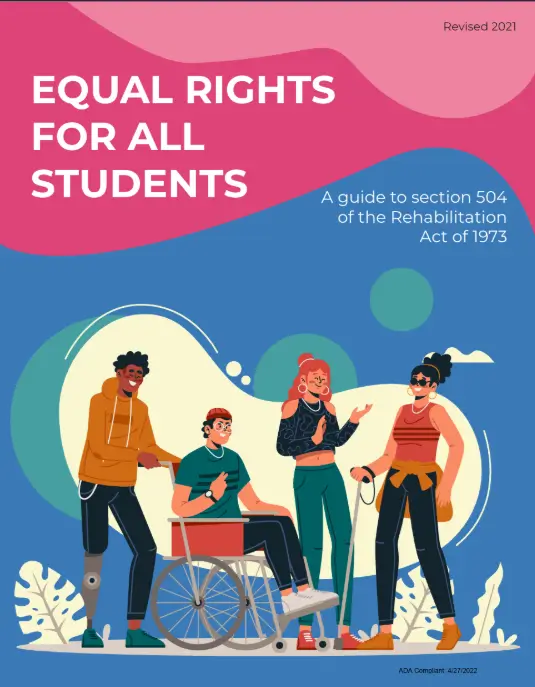
The Utah State Board has produced the Equal Rights for All Students: A Guide to Section 504 of the Rehabilitation Act of 1973. This guide is available in English and Spanish. Additional parent and educator resources are available at the USBE Website under Educational Equity
Family Education Rights and Privacy Act
FERPA or the Buckley Amendment
The Family Education Rights and Privacy Act of 1974 (P.L. 93-380, FERPA), also known as the Buckley Amendment:
The Family Education Rights and Privacy Act of 1974 (P.L. 93-380, FERPA), also known as the Buckley Amendment:
- Guarantees you the right to inspect and review your child’s file. You also have the right to receive copies of the file information.
- Says that only people who need to see the file can see it.
- Allows you to challenge information in the file you feel is inaccurate or misleading.
- Allows you to ask the school to remove something in the file that you disagree with. If the request is denied, you have at least two options:
- You may attach a statement to the page in question telling why you disagree.
- You may request a hearing (However, consider the value of this formal process and what you need to accomplish).
The McKinney-Vento Act
Subtitle VII-B of The McKinney-Vento Homeless Assistance Act (Section 725) authorizes the federal Education for Homeless Children and Youth (EHCY) Program and is the primary piece of federal legislation related to the education of children and youth experiencing homelessness. It was reauthorized in December 2015 by Title IX, Part A, of the Every Student Succeeds Act (ESSA). The 2004 reauthorization of IDEA also includes amendments that reinforce timely assessment, inclusion, and continuity of services for homeless children and youth who have disabilities. Following are a few of the provisions. For more detail, contact the Utah Parent Center.
Who is considered homeless?
Anyone who lacks a fixed, regular and adequate nighttime residence including:
- Sharing the housing of others due to lack of housing, economic hardship, or similar reason
- Living in motels, hotels, trailer parks, camping grounds, due to lack of adequate alternative accommodations
- Living in emergency or transitional shelters
- Abandoned in hospitals,
- Awaiting foster care placement
- Living in a public or private place not designed for humans to live
- Living in cars, parks, abandoned buildings, public train stations, etc.
- A migrant child who qualifies under any of the above
The Educational Rights for Children and Youth Experiencing Homelessness
- A homeless education liaison in every public school district
- Right to immediate enrollment in school where seeking enrollment without proof of residency, immunizations, school records, or other documents
- Right to choose between the local school where they are living, the school they attended before they lost their housing, or the school where they were last enrolled
- Right to transportation to their school of origin
- Right to be free from harassment and exclusion. Segregation based on a student’s status and homelessness is strictly prohibited.
- Right to access to educational services for which they are eligible including IDEA services, ESL, gifted and talented programs, vocational/technical education, and school nutrition programs.
- Right to be notified of their options and rights under McKinney-Vento. Liaisons must post rights of students experiencing homelessness in schools and other places in the community.
- Right to have disagreements with the school settled quickly
Note:
The previous pages provided an overview of several laws which protect individuals with disabilities including the Individuals with Disabilities Education Act (IDEA). The following pages provide detailed information about the process of planning for a child’s special education program and the parents’ role in it as outlined in the IDEA.
IDEA 2004 requires that the school keep copies of school records if not having copies would prevent the parent from inspecting and reviewing those records. §300.613
Need Help from a Parent Consultant?
UPC parent consultants offer free, one-on-one guidance to help Utah families understand Early Intervention, Special Education, IEPs, and their rights.